
Listening to the Silence of Dementia
“In the song of silence, love needs no words, and connection lives beyond sound.”


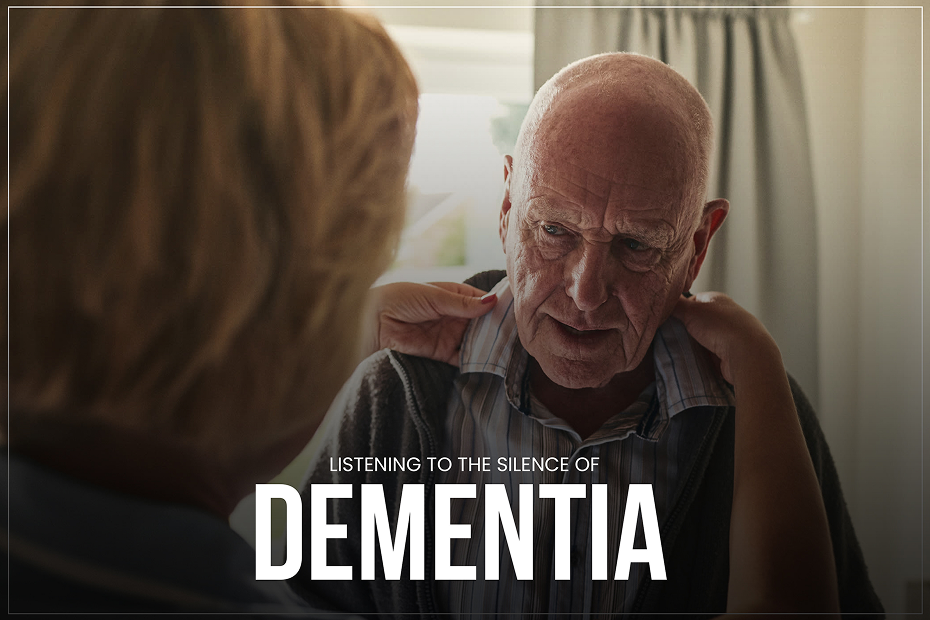
There comes a time in the dementia journey when words begin to fade, not all at once, but gradually, like the setting sun dimming into twilight. For my father, that silence arrived quietly, without announcement. Not with sudden silence, but a slow fading, like the tide quietly receding. And finally, the once eloquent man who could weave stories with words slipped into a world beyond language.
Yet, in that wordless space, I discovered something profound: silence does not mean absence. Even when dementia stole his speech, it could not steal our connection.
The Storyteller Silenced
My Father, whom I lovingly called “Baba”, had always been a storyteller; his voice carried warmth, wit, and wisdom. Baba was once an eloquent orator and prolific writer. His voice carried warmth, wit, and wisdom. His stories could make us laugh, reflect, or simply sit in awe.
Once, on a train to Sonarpur, his ghost story was so gripping that a passenger missed his stop just to hear the ending.
But as dementia advanced, words began slipping away. By 2019, he struggled to form sentences, eyes searching for language that no longer came. Eventually, he stopped trying. The storyteller went quiet. It was heartbreaking to witness.
I remember sitting beside him, trying to start conversations, waiting for a response that never came. At first, I filled the air with my own words, desperate to bridge the growing distance. But over time, I learned that silence, too, was a form of communication. His hand tightening around mine, the faint smile that flickered when I played his favorite Tagore songs, these became his language.
Dementia had taken away words, but it had not taken away feeling. It had not taken away love.
Learning a New Language
As caregivers, we often think of communication as something spoken. But with dementia, we must learn to listen differently, with our hearts, with our senses, and with patience.
Despite his cognitive decline, the essence of Baba was still there, alive in his eyes, his gestures, and his quiet expressions. If he wanted to eat or do something, he would grab it or point at it. His communication was no longer verbal but emotional—spoken through tone, touch, and energy
- A blink of recognition when he heard a familiar voice.
- A sigh that expressed comfort or fatigue.
- The faint tap of his fingers when he heard music.
These were his sentences now, small, delicate expressions of presence.
Ma trained his caregivers to read him, to notice the tiny flicker in his eyes, the wrinkle of discomfort on his forehead, the subtle shift of his hands. Slowly, they too became fluent in his silence.
He could no longer understand most words, yet his emotional radar was razorsharp.
If we raised our voice, he recoiled.
If there was tension, he shut down.
If we smiled, he softened instantly.
“Dementia does not dull emotional perception—it intensifies it.”
A calm environment became sacred. We learned never to argue or express frustration in his presence. Love had to be the language he heard most clearly.
Communication Beyond Words
He could no longer tell us if he was hungry or uncomfortable, so we built routines—timed meals, bathroom visits, and predictable cues.
We used gentle tones, simple phrases, and expressive gestures. Sometimes, cue cards or pictures replaced words. But even when he couldn’t understand what we said, he always understood how we said it. It was no longer about testing memory; it was about affirming presence.
A soft pat on his arm, a gentle shoulder rub, holding his hand—these became our
silent promises:
“You are not alone. We are here.”
And often, when surrounded by familiar faces and warmth, Baba would smile. A quiet reassurance that love had reached him beyond words. Dementia strips away memory, logic, and expression, but emotion remains untouched till the very end. A soft tone, a familiar touch, the smell of jasmine, these sensory cues often reached him more deeply than any sentence could.
He no longer spoke, but his eyes still searched for connection.
He no longer called my name, but his hand still reached for mine.
He no longer remembered the stories we shared, but he still remembered love, not
through memory, but through instinct.
The essence of communication in late-stage dementia lies in being, not speaking. It’s about showing up, sitting in shared quiet, and letting your loved one feel your steadiness.
“When vocabulary fades, love finds its own voice.”
Caregiver Corner: Quick Reminders
- Listen with your eyes. Notice gestures, expressions, and body cues.
- Stay calm. Emotions are contagious—yours shape theirs.
- Use gentle touch. Physical presence can soothe without speech
- Keep language simple and kind. Tone carries more weight than meaning
- Train caregivers to observe. Small cues often reveal big needs.
Reflections
The “silence before the silence” is perhaps the hardest phase for any caregiver. But it is also the phase that teaches us the purest form of love: one that asks for nothing in return
Through that silence, I found peace. I learned to sit quietly by Baba’s side, to let the ticking clock and our synchronized breathing fill the room. Those moments became sacred, a language only we could understand.
To every caregiver walking this final stretch, know that even in silence, you are still being heard. Your love is felt, your presence is known. Words may fade, but the heart remembers. Always. In silence, we learned to speak with the heart.
Because in the end, dementia may silence the voice, but it can never silence love.